The Cambridge Companion to Mark Twain by Forrest G. Robinson
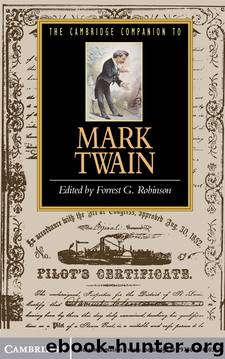
Author:Forrest G. Robinson [Forrest G. Robinson]
Language: eng
Format: epub
ISBN: 9780521440363
Publisher: Cambridge University Press
NOTES
1This essay was first published in the Mark Twain Journal. It has been reprinted in M. Thomas Inge, ed., Huck Finn Among Critics (Frederick, Md.: University Publications of American, 1985), pp. 247–65; James S. Leonard, Thomas A. Tenney, and Thadious M. Davis, eds., Satire or Evasion? Black Perspectives on “Huckleberry Finn” (Durham, N.C.: Duke University Press, 1992), pp. 10320; Eric Sundquist, ed., Mark Twain: A Collection of Critical Essays (En-glewood Cliffs, N.J.: Prentice-Hall, 1994), pp. 90–102.
2Louis R. Harlan and Raymond W. Smock, eds., The Booker T. Washington Papers, Vol 10:1909–11 (Urbana: University of Illinois Press, 1981), pp. 34850. Reprinted from North American Review 191 (June 1910): 828–30.
3Ibid., pp. 349–50
4Ibid., p. 349.
5Shelley Fisher Fishkin, Was Huck Black? Mark Twain and African-American Voices (New York: Oxford University Press, 1993), p. 106.
6Sterling Brown, The Negro in American Fiction (Washington, D.C.: Associates in Negro Folk Education, 1937), p. 68. Reprinted by Arno Press, New York, 1969.
7The conflict regarding acceptable forms of racial humor has been one of the sharpest and most enduring rifts in black intellectual culture. The controversy over the Amos ’n Andy television show in the 1950s, a radio favorite among the black masses that was reviled by the black elites and ultimately suppressed by a successful NAACP campaign, exemplifies the class politics of this issue. The history of these conflicting responses has been most recently addressed by Mel Watkins in On the Real Side: Laughing, Lying, Signifying – The Underground Tradition of African-American Humor That Transformed American Culture, from Slavery to Richard Pryor (New York: Simon & Schuster, 1994).
8Brown, The Negro in American Fiction, p. 69.
9John H. Wallace, “The Case Against Huck Finn,” in Satire or Evasion? ed. Leonard et al., p. 16.
10Ibid., p. 17.
11Fredrick Woodard and Donnarae MacCann, “Minstrel Shackles and Nineteenth-Century ‘Liberality,’ ” in Satire or Evasion? ed. Leonard et al., p. 142.
12One strain of scholarship emphasizes the use of universal comic archetypes in minstrelsy and argues that minstrelsy presents a complex interplay between notions of racial difference and acknowledgments of common humanity. Such critics include Constance Rourke and Ralph Ellison, who was deeply influenced by Rourke’s work. Robert Toll’s work, based on a more thorough survey of the traditions within minstrelsy, distinguishes among the various kinds of portrayals and the contrasting social and political perspectives among minstrel troupes and performers. Toll’s detailed account of the evolution of minstrelsy over many decades undercuts the conflation of minstrelsy into a single, simple phenomenon; and his consideration of African-American minstrels explodes the common misconception that blackface comedy was merely a white man’s game. Most recently, Eric Lott has brought the subtle tools of contemporary cultural studies to bear on minstrelsy, examining its appropriations of black culture, the complexly ambivalent dynamics between contempt for and fascination with African-Americans, and the role of minstrelsy in creating a multicultural consciousness in America. The work of these scholars enables us to understand minstrelsy in much more subtle, detailed, and sophisticated terms. See Constance Rourke, American Humor: A Study of the National Character (New York: Harcourt, Brace, 1931); Ralph Ellison, Shadow and Act (New York: Vintage Books, 1972); Robert C.
Download
This site does not store any files on its server. We only index and link to content provided by other sites. Please contact the content providers to delete copyright contents if any and email us, we'll remove relevant links or contents immediately.
4 3 2 1: A Novel by Paul Auster(12354)
The handmaid's tale by Margaret Atwood(7729)
Giovanni's Room by James Baldwin(7301)
Asking the Right Questions: A Guide to Critical Thinking by M. Neil Browne & Stuart M. Keeley(5741)
Big Magic: Creative Living Beyond Fear by Elizabeth Gilbert(5726)
Ego Is the Enemy by Ryan Holiday(5392)
The Body: A Guide for Occupants by Bill Bryson(5065)
On Writing A Memoir of the Craft by Stephen King(4920)
Ken Follett - World without end by Ken Follett(4705)
Adulting by Kelly Williams Brown(4552)
Bluets by Maggie Nelson(4534)
Eat That Frog! by Brian Tracy(4499)
Guilty Pleasures by Laurell K Hamilton(4422)
The Poetry of Pablo Neruda by Pablo Neruda(4079)
Alive: The Story of the Andes Survivors by Piers Paul Read(4009)
White Noise - A Novel by Don DeLillo(3990)
Fingerprints of the Gods by Graham Hancock(3979)
The Book of Joy by Dalai Lama(3960)
The Bookshop by Penelope Fitzgerald(3827)
